QUICK ANSWER
The short version
Hussien Issa started a retail business with his brother and helped scale it. That experience exposed a gap between recording transactions and understanding what the business should do next. The software as a service and point of sale systems they used did not offer the connected view he believed owners needed, so he conceived and developed Vanteloq. The advisory work began as Lexedge Consulting and now operates as Vanteloq Advisory within Vanteloq Inc. The central lesson is that retail business intelligence should connect reliable sales, inventory, margin, cash and operating records to a specific decision. A useful report explains what changed, identifies missing context and gives the next action a clear owner.
 Vanteloq guideA practical way to read this guide
Hussien Issa started a retail business with his brother and helped scale it. That experience exposed a gap between recording transactions and understanding what the business should do next. The software as a service and point of sale systems they used did not offer the connected view he believed owners needed, so he conceived and developed Vanteloq. The advisory work began as Lexedge Consulting and now operates as Vanteloq Advisory within Vanteloq Inc. The central lesson is that retail business intelligence should connect reliable sales, inventory, margin, cash and operating records to a specific decision. A useful report explains what changed, identifies missing context and gives the next action a clear owner.
An educational character, not professional accounting or legal advice.What to Keep in View
- Retail data becomes useful when it answers a clear operating decision instead of adding another disconnected dashboard.
- Sales, inventory, margin and cash measure different parts of the business and should be reviewed together without treating them as interchangeable.
- Vanteloq Advisory provides consulting, analytics and implementation, while Vanteloq Workspace is the business intelligence software operated by Vanteloq Inc.
The Operating Problem Came Before the Product
Hussien Issa started a retail business with his brother and helped scale it. Working inside the business put ordinary retail decisions in front of him: what was selling, which inventory deserved more cash, where margin was changing and what the team needed to do next. Those questions were connected in the store even when their records appeared in separate systems.
The software as a service and point of sale systems they used had limitations. They could record important activity, but they did not offer the connected view Hussien believed business owners needed. Those firsthand gaps led him to conceive and develop Vanteloq. They also shaped Vanteloq Advisory, which helps businesses improve growth and operations through structured analysis and implementation.
A Point of Sale Record Is Only the Beginning
A point of sale system can create a dependable record of transactions, products and payment activity. That record matters, but it does not automatically explain why a result changed or which action deserves priority. A sales total may rise while margin falls. A popular item may sell quickly but stay unavailable too often. A strong month can still create cash pressure when inventory purchases and other payments arrive first.
Statistics Canada's Monthly Retail Trade Survey collects information about sales, internet sales, inventories and commodities. Those separate topics illustrate why one number cannot describe the whole retail operation. A retailer needs definitions that match across systems and enough context to compare products, periods and locations fairly. The purpose of retail analytics is to make a decision more inspectable, not to make every chart look certain.
Inventory, Margin and Cash Tell Different Parts of the Story
Inventory has an operating role and a financial role. It supports customer demand, but it also commits cash before every item is sold. Canada Revenue Agency guidance explains that inventory is used to calculate cost of goods sold and net income. BDC's inventory guidance also warns that too much stock can tie up cash and floor space, while too little can cost sales. These relationships make inventory a management question, not only a count on a shelf.
A useful review keeps the measures distinct. Units sold show movement. Gross profit connects net sales with product cost. Inventory availability reveals whether the store could meet demand. A dated cash view shows when money is expected to enter and leave the business. Reading these measures together can expose a better question, but none of them should be used as a substitute for the others.
Retail Analytics Needs Definitions, Evidence and Ownership
A dashboard is trustworthy only when the team understands where its numbers came from. Product identifiers, returns, discounts, transfers, tax treatment and missing costs can all change the meaning of a retail report. Before interpreting a trend, confirm the period, source and calculation. Mark assumptions clearly when a record is incomplete instead of turning an estimate into a fact.
Then connect the finding to the operating rhythm of the business. A useful exception report should identify what moved enough to deserve attention, who will investigate it and when the decision will be reviewed. That process keeps retail business intelligence close to real work rather than creating a reporting layer that nobody owns.
- Question: Which decision must this report support?
- Evidence: Which sales, inventory, cost and cash records support the observation?
- Limit: What is missing, estimated or outside the selected period?
- Action: Who will respond, and when will the result be reviewed?
Why Vanteloq Grew From the Gap
Hussien did not begin with the goal of adding another generic business dashboard. The idea for Vanteloq came from using retail systems and seeing the distance between the data they captured and the practical questions an owner still had to answer. He formulated and developed Vanteloq around that gap.
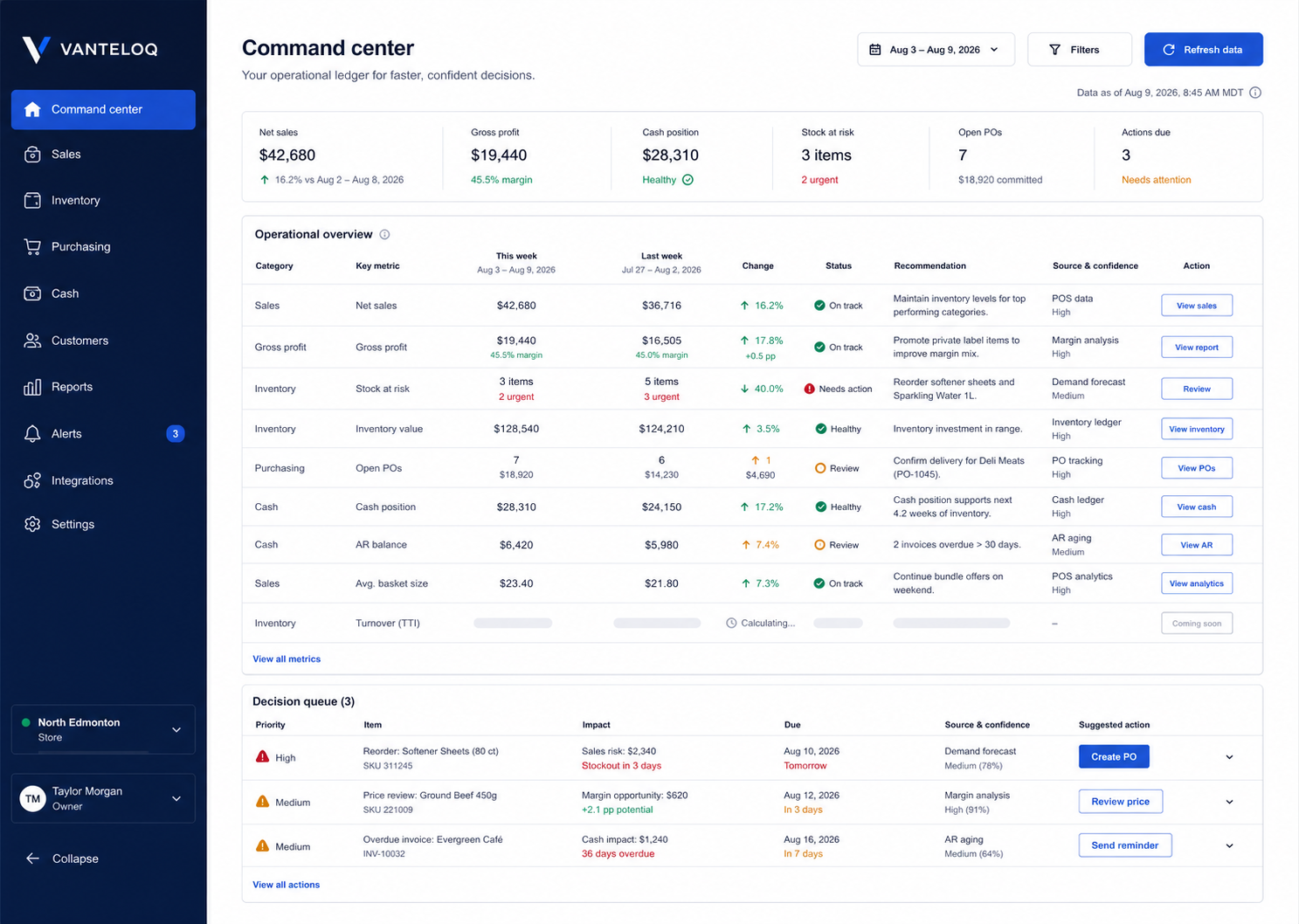
Vanteloq Workspace is the business intelligence software operated by Vanteloq Inc. Its role in the brand is to support a clearer path from business records to analysis and action. A retailer should still evaluate the quality and coverage of its source records, the decisions the software supports and the people responsible for acting. Technology can organize evidence, but ownership and judgment remain part of the operating system.
How Vanteloq Advisory and Workspace Work Together
Vanteloq Inc. provides two related offers. Vanteloq Advisory helps a business define what it is trying to improve, examine the relevant evidence and implement a practical change. Vanteloq Workspace provides the software for keeping approved records, analysis, decisions, responsibilities and follow-up work connected.
This structure reflects Hussien's path from starting a retail business with his brother and helping scale it to conceiving and developing Vanteloq. A business can use Advisory or Workspace independently, or combine them when a changed process needs a dependable place for recurring review. The standard remains the same: reporting should help the business understand what changed, decide what matters and put the next improvement to work.
Sources and further reading
These sources support the operational, financial, platform or technical boundaries discussed in this guide. They are not endorsements of Vanteloq.
- Retail Trade Survey (Monthly)Statistics Canada
- Inventory and Cost of Goods SoldCanada Revenue Agency
- Inventory Management: A Guide for EntrepreneursBusiness Development Bank of Canada
- Vanteloq AdvisoryVanteloq