 ™
™
QUICK ANSWER
The short version
Traditional accounting software is built to maintain financial records across banking, invoicing, expenses, reporting and month-end work. BookLoQ uses the same need for controlled records, then organizes the owner experience around commerce activity, supporting evidence and cash decisions. Its current public capabilities include posted journals, financial statements, transaction review and evidence matching, a month-end checklist and a 13-week cash forecast with visible assumptions. The difference should be judged through those workflows, not unsupported claims about speed, accuracy or universal superiority.
Start with a credible accounting foundation
Traditional accounting software can cover bank feeds, invoices, bills, expenses, reports, inventory, projects, permissions and month-end work. Those capabilities are useful because a business still needs balanced journals, reliable financial statements, reconciled accounts and controlled access.
BookLoQ does not avoid that foundation. Posted journals flow into the trial balance, profit and loss statement and balance sheet. Imported transactions can be reviewed, assigned supported categories and matched to bills, invoices or receipts. The design opportunity is to make those controls understandable without placing every advanced setting in the owner's daily path.
How BookLoQ fits beside other financial tools
Financial products are built around different primary jobs. This chart compares typical product categories, not every provider or plan. Capabilities vary, and a business may use more than one category.
Swipe or scroll horizontally to compare every category.
| Capability | BookLoQ today | General accounting software | Commerce settlement tools | Reporting and planning tools |
|---|---|---|---|---|
| Primary job | Review commerce-related financial records, supporting evidence, journals, statements and near-term cash in one workspace. | Maintain books across banking, invoices, bills, expenses, reporting and month-end work. | Break commerce settlements into sales, refunds, fees, taxes and deposits. | Turn accounting data into management reports, KPIs, forecasts and scenarios. |
| Accounting record | Keep posted journals and financial statements beside imported source records. | Commonly serve as the accounting system of record. | Usually prepare summarized entries for an accounting system. | Usually read from accounting systems rather than posting the books. |
| Evidence and review | Keep invoices, receipts, matched records, statuses and unresolved work visible for human review. | Attachments, bank rules and review depth vary by product and plan. | Centre evidence on settlement batches and payout matching. | Usually explain variances from imported data rather than managing original evidence. |
| Commerce context | Bring sales, documents, accounting records and cash context together. Depth depends on connected or imported sources. | May receive commerce summaries or application data. Transaction detail varies by connection. | Specialize in settlement composition and payout-to-deposit matching. | Usually analyze summarized operational and financial data. |
| Cash planning | Provide a 13-week forecast with verified opening cash, confirmed commitments, expected receipts and visible assumptions. | Cash-flow reporting and forecasting vary by product and plan. | Cash forecasting is usually outside the primary workflow. | Forecasts, budgets and scenarios are common, using imported actuals and assumptions. |
| Review workflow | Prioritize open items with their source, status, owner and next action. | Rules, matching and approval workflows vary by product and plan. | Focus review on mappings, exceptions and payout differences. | Focus review on variances, assumptions and management commentary. |
| Automation boundary | Suggestions remain subject to authorized human review. Vanteloq AI cannot post journals or approve payments. | Automation varies; users remain responsible for review, filing and professional judgment. | Automate mapping and summary preparation, with exceptions left for review. | Explain trends and scenarios; source quality and assumptions still govern the result. |
| Current limits | BookLoQ does not file returns, move money or certify completeness. QuickBooks connectivity remains sandbox-only. | Tax, payroll, payments and filing differ by region and subscription. | Require supported commerce channels and an accounting destination. | Depend on connected accounting and operating data. |
Follow the complete sale-to-bank trail
A bank deposit does not explain the commerce activity behind it. A payout can include sales, discounts, returns, tax, processing fees, reserves and adjustments. Recording only the deposit can hide that composition or create duplicate revenue when operating sales records are also present.
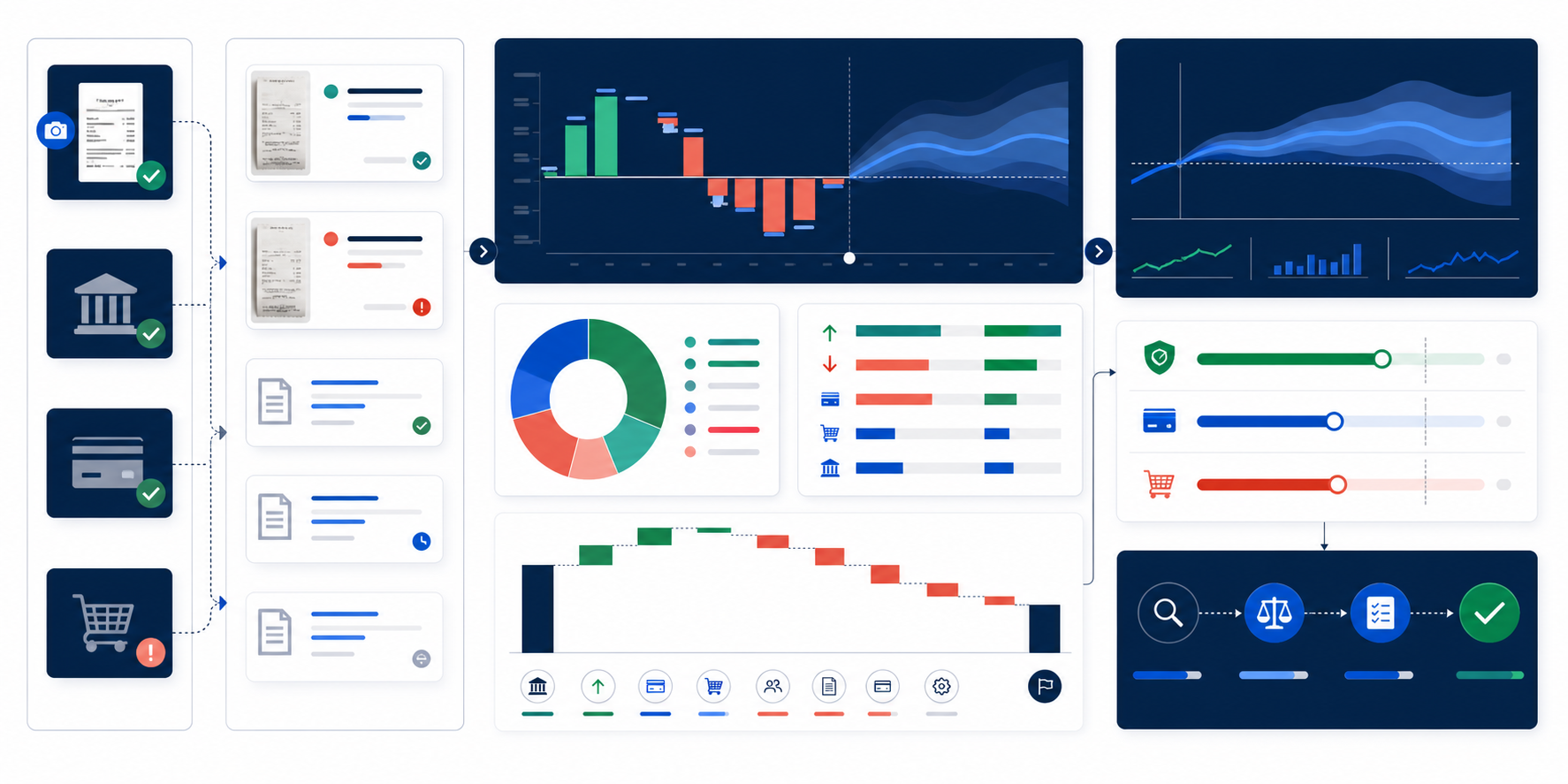
BookLoQ's strongest direction is a traceable chain from the sale through the payout and into the ledger. A user should be able to begin with a bank deposit, journal line or financial-statement total and follow the records in either direction.
Each step should retain its source, amount, status and relationship to the next record so the same sale is not counted twice.
Turn reconciliation into a review workspace
Modern financial workflows separate clear matches from items that still require judgment. A useful review screen places the bank item, proposed match, related document, explanation and remaining difference together. The reviewer can accept the proposal, choose another record, correct the classification or leave the item unresolved with a reason.
BookLoQ already includes transaction review, record matching and a month-end checklist. Developing those capabilities as one evidence-led queue would help a user answer what the system attempted, why an item remains open and what action will resolve it.
Keep documents beside the proposed accounting treatment
Invoice and receipt capture is useful when a reviewer can compare proposed fields with the original record. Supplier, date, amount, tax, category and line items should remain visibly provisional until an authorized person accepts or corrects them.
The workflow should distinguish uploading, reviewing, approving, posting and paying. Those actions have different meanings, permissions and audit consequences. Keeping the document, extracted values, changes and review history together makes the record easier to explain later.
Connect inventory decisions to cash
Financial reports explain recorded activity. Commerce owners also need to understand what a proposed purchase could do to cash. BookLoQ's 13-week forecast starts with verified opening cash, separates confirmed commitments from expected receipts and keeps its assumptions visible.
A proposed stock purchase can therefore be reviewed as a cash decision rather than an isolated order. The useful context includes payment timing, known obligations, expected receipts, the lowest projected balance and the owner's safety threshold. Uncertain receipts should remain in a planning case instead of increasing the conservative cash estimate.
Show the state of the work
Financial records move through stages. Imported does not mean reviewed. Categorized does not mean approved. Posted does not mean reconciled. Paid does not prove that the correct source document is attached.
Each BookLoQ task should show its status, owner, evidence, next action and effect on the ledger or forecast. Connection status deserves the same clarity: available, authorized, synchronized, mapped, reviewed and ready for reporting are different states.
- Keep proposed and approved values visually distinct.
- Explain why an item needs review instead of showing a generic warning.
- Preserve who changed or approved a record and when.
- Show missing or stale source data instead of treating it as zero.
Compare observable workflows
BookLoQ should be compared through defined tasks, not broad claims that it is faster, more accurate or universally better. Useful tests include tracing a payout, resolving an uncertain transaction, verifying a document, preparing month-end work and testing an inventory purchase against cash.
Those outcomes need representative data and measured task criteria before they support a performance claim. Until then, BookLoQ's public case is specific: it brings commerce activity, accounting evidence and cash consequences into one reviewable workspace.
Sources and further reading
These sources support the accounting, platform or technical boundaries discussed in this guide. They are not endorsements of Vanteloq.
- BookLoQ accounting and cash flow for small businessesVanteloq
- Setup, BookLoQ, reports and AI privacyVanteloq Help Centre
- Vanteloq pricing and BookLoQ availabilityVanteloq
- Service limits and customer responsibilitiesVanteloq